Comprehensive Training
Confidence for the people who serve.
Church technology is often operated by volunteers with very different levels of experience. We provide practical, hands-on training that helps your team understand the systems they use and operate them with confidence.
Start a conversation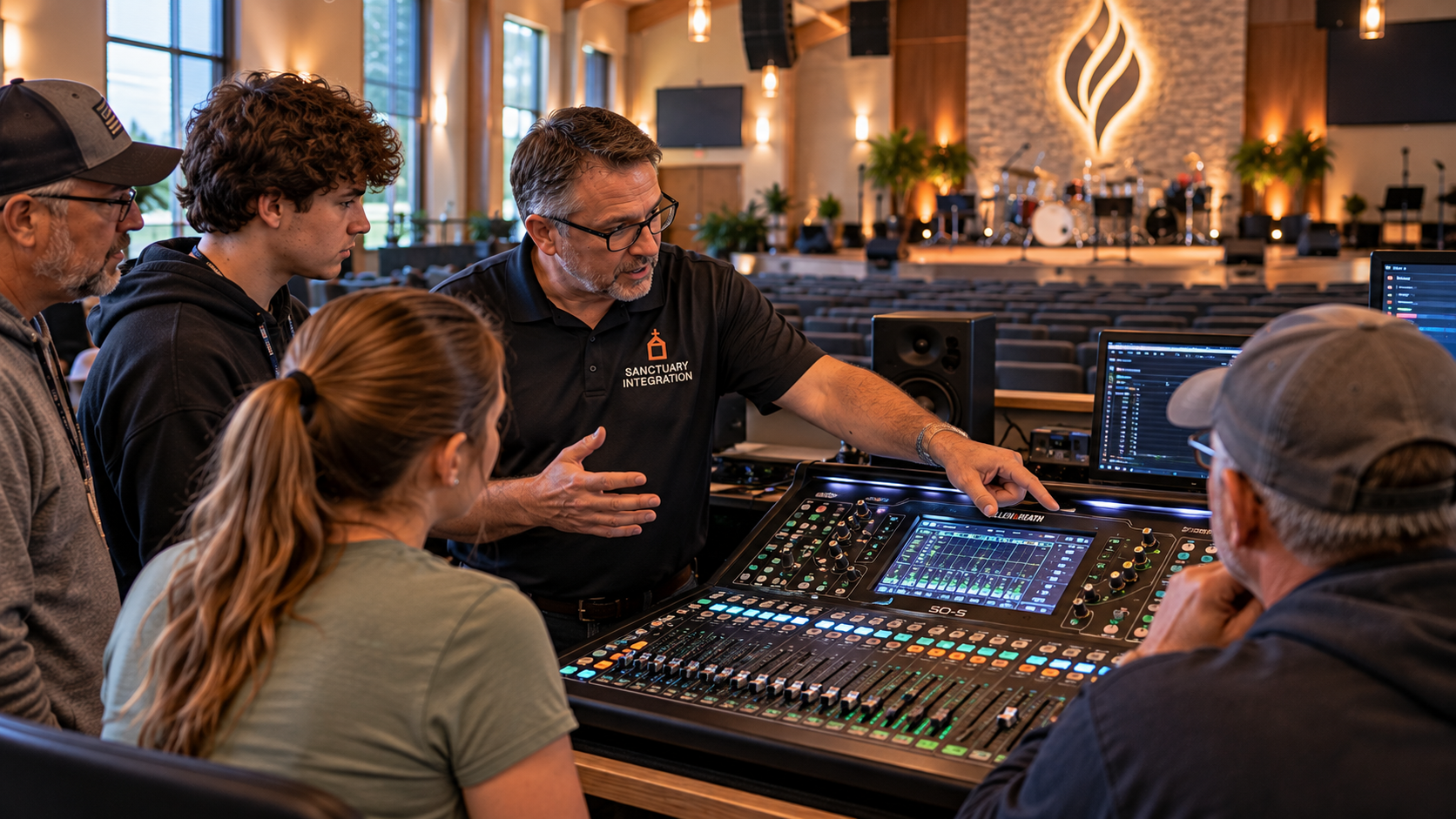
Knowing which buttons to push isn't the same as understanding the system.
Some volunteers have years of experience. Others may be serving for the first time. And sometimes nearly everything the church knows about its technology lives with one person.
That creates familiar situations:
- “When our regular sound person isn't here, everybody gets nervous.”
- “We know which buttons to push, but we don't understand why.”
- “We need to train new volunteers, but we don't know where to begin.”
Teach the why, not just the buttons.
Someone can memorize a sequence of steps without understanding what's happening. That works until something changes.
A different microphone gets used. Someone changes an input. A setting gets moved. The regular operator isn't there. The livestream signal disappears.
When volunteers understand some of the reasoning behind the system, they're better equipped to recognize problems and make appropriate decisions.
Training should answer both:“What do I do?”and“Why am I doing it?”
Understanding builds confidence.
Training built around your system.
Generic training videos can be useful. But they don't know your console, your stage connections, your cameras, your livestream routing or what happens during your Sunday service.
Whenever practical, training is built around your church's actual equipment, facility, workflow, volunteers and ministry needs.
The best training connects knowledge to what your volunteers actually do on Sunday.
Training for the systems your team uses.
Training should match the systems your church actually operates and the experience level of the people receiving it.
Audio
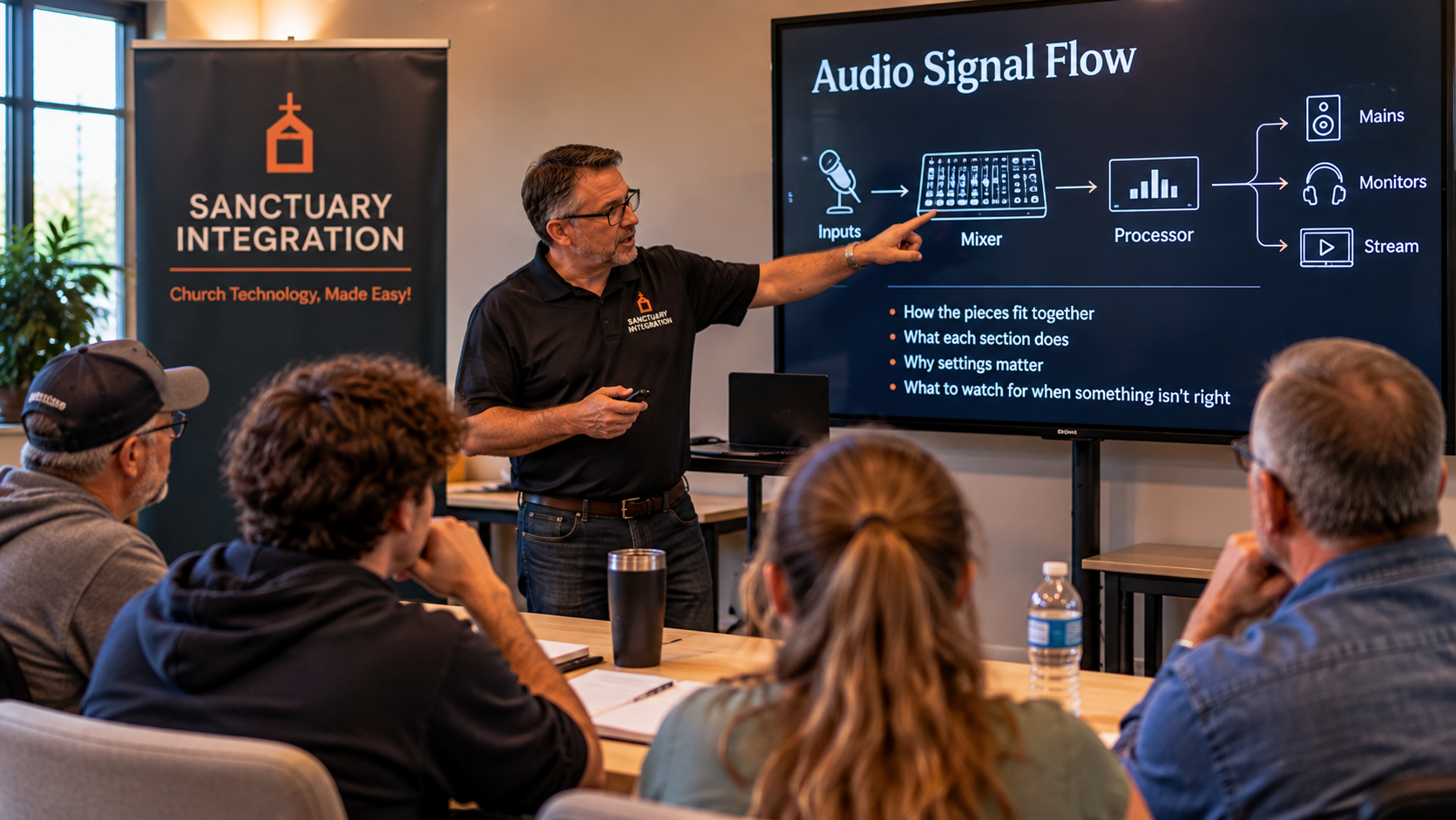
Signal flow, gain structure, microphones, mixing, EQ, compression, monitoring, wireless practices, scenes, streaming audio and troubleshooting.
Video & Presentation
Camera operation, framing, switching, lyrics, graphics, livestream workflow and presentation systems.
Lighting
Platform illumination, lighting for cameras, fixture control, scenes, presets and troubleshooting.
Streaming & Production
Starting and ending streams, audio, switching, monitoring, encoder basics, volunteer roles and recovery procedures.
Volunteers should know what normal looks and sounds like before they're expected to recognize when something is wrong.
Train for Sunday morning.
Training shouldn't happen only in an abstract classroom environment.
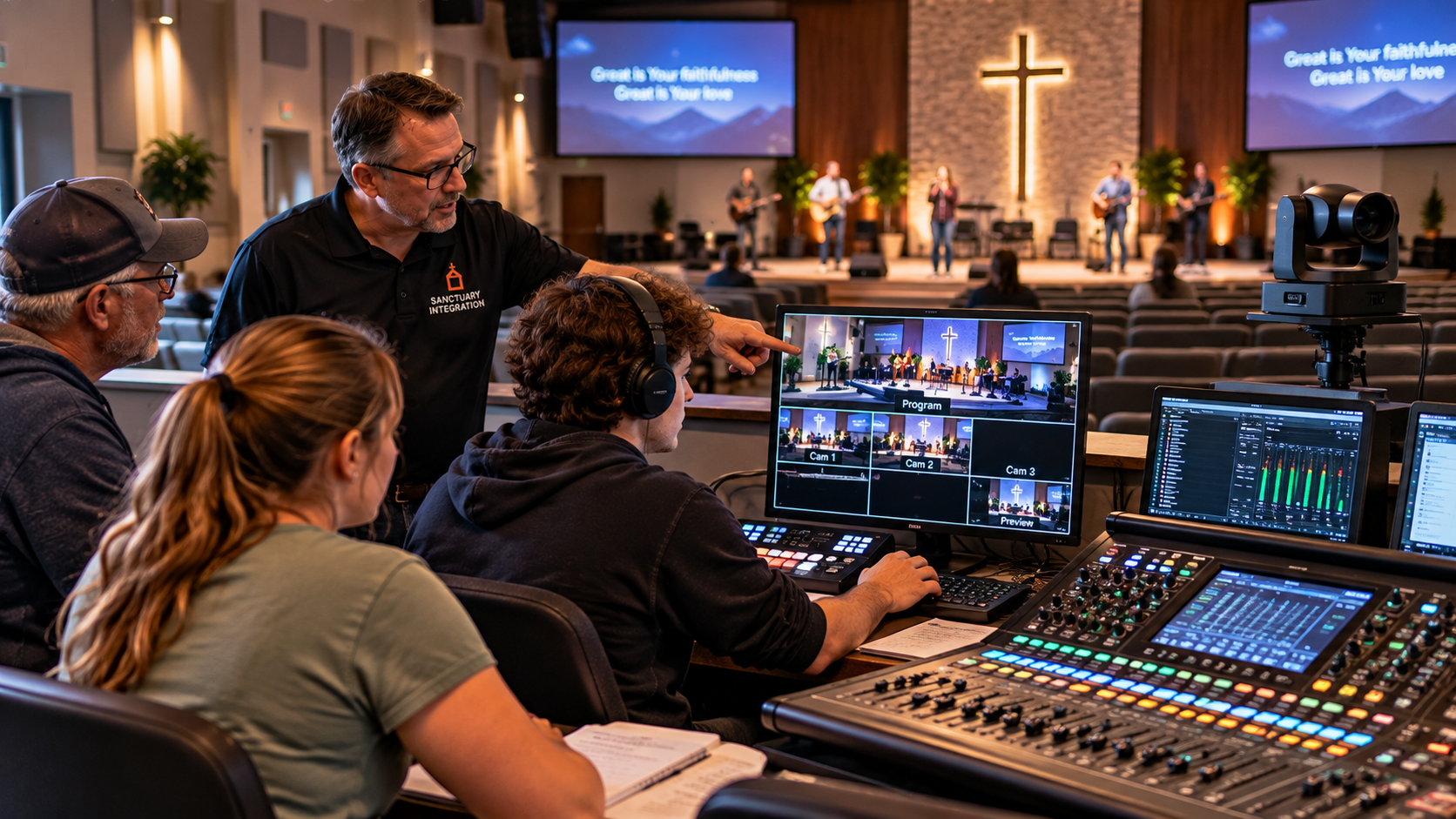
We can work through situations volunteers actually encounter:
- Preparing the system
- Soundcheck and pastor microphones
- Worship-team changes
- Presentation cues and transitions
- Starting and monitoring the livestream
- Responding to unexpected problems
- Shutting systems down properly
Practice should resemble the environment in which people will actually serve.
Knowledge shouldn't live in one person's head.
One of the greatest risks in a church technology ministry is having nearly all of the knowledge concentrated in one person.
People take Sundays off. Volunteers move. Ministry roles change.
A healthy technical ministry develops multiple people who understand the essential systems and workflows.
Training doesn't just develop operators.It develops depth in the team.
Create a safe place to learn.
Technology can be intimidating. Volunteers may hesitate to ask questions because they think everyone else already knows the answer—or they're afraid they're going to break something.
Training should encourage questions. Mistakes during training can become valuable teaching moments.
There are no embarrassing questions when someone is learning to serve.
The objective is confidence—not showing people how much the instructor knows.
Training isn't a one-time event.
Teams, equipment and workflows change. People forget things they don't use frequently.
Training can support:
- new volunteers
- refreshing existing volunteers
- developing team leaders
- reviewing procedures
- training after system changes
- addressing recurring problems
- building internal knowledge over time
A sustainable ministry keeps learning.
Build a team that's ready to serve.
Your volunteers don't need to become engineers.
They need enough understanding, practice and confidence to use the technology responsibly—and enough support to know what to do when something doesn't go as expected.
Help your people understand the system.Give them room to practice.Build confidence that lasts beyond one Sunday.
Start a conversation